Yesterday at Costco Wesley walked along pushing the cart. We began to pass a man who had what appeared to be a child, perhaps 6 or 7, sleeping in the cart when he suddenly stopped to engage Wesley. With a gigantic smile, he held out his fist to give him knuckles.
“Hi buddy!” he said as if he knew Wes.
Wes happily obliged in giving him knuckles.
“How are you?” he said with his smile getting even bigger.
He looked at me, “How old is he?”
“He’s 21,” I told him.
He pointed to his son in the cart. “He is 18!”
I walked over to say hello. He wasn’t a young child. He was a child like ours. He had special needs.
We stood there for a few minutes in the frozen section of Costco. People hurried by as we talked about our boys. It wasn’t about exchanging information. It was about being, even if briefly, with someone who lives in my world.
Their life is as mine. Without being told, I know things about these strangers. I know this man or his wife has a hospital bag in his closet. There sits an already packed bag just in case that fever isn’t just a blip but the start of an extended hospital stay. Their arms are tired every single night from maneuvering their son. I know they hook up a feeding tube to give their child the basic sustenance to live. They try to balance time with the other children but some days they just can’t and it is no one’s fault though it feels as if it should be. They carry the weight of how their children are impacted. Though they will likely grow to be kinder and more compassionate adults, there is still a cost. I look at his beautiful wife whose smile is just as big and know he has a supportive spouse. Their friends try to understand but can’t possibly because they always only pass through.
And I know they have cried over the simplest victory. They celebrate every smile and every laugh. Their life is amplified. They take nothing for granted and lay down each night and thank God for one more day with their son.
Being the parent of a child with special needs is something like being a citizen in a foreign land. You appear to be like everyone else but your culture is different. The way your family eats is not like others. Though you speak the same language, yours includes words and acronyms the others don’t know. Your family can’t attend events unless they intentionally turn down the volume and the house lights are just half dark. Sensory friendly events are few and even fewer are churches to welcome the entire family. Days are filled with vital stats checks and diaper changes and medications. Some nights sleep is regular and others it consists of only two hours. There is no rhyme or reason. It is just how it is.
Complete assimilation just isn’t possible even though you once lived with the same customs your friends luxuriously enjoy. As much as they don’t understand yours, you can no longer imagine life being any other way than how it has become. For it to be any different would mean the worst of nightmares.
But then you see a couple and even though they are strangers, you recognize a familiarity that is not just welcomed. It is sought. They know the words you do. They don’t just sympathize. They empathize because they live there too. The only thing you may have in common with them is that but the weight and joy of that encompasses who you are. So you just stand there for a few moments. You feel your soul relax in a way it only can when you are with fellow inhabitants.
For a fleeting few moments the abnormality of your life isn’t there. You soak in the seconds when abnormal is normal. And you smile and thank these strangers, these co-inhabitants, for stopping to give knuckles to Wesley and a smile to your heart.
Tag: ASD
-
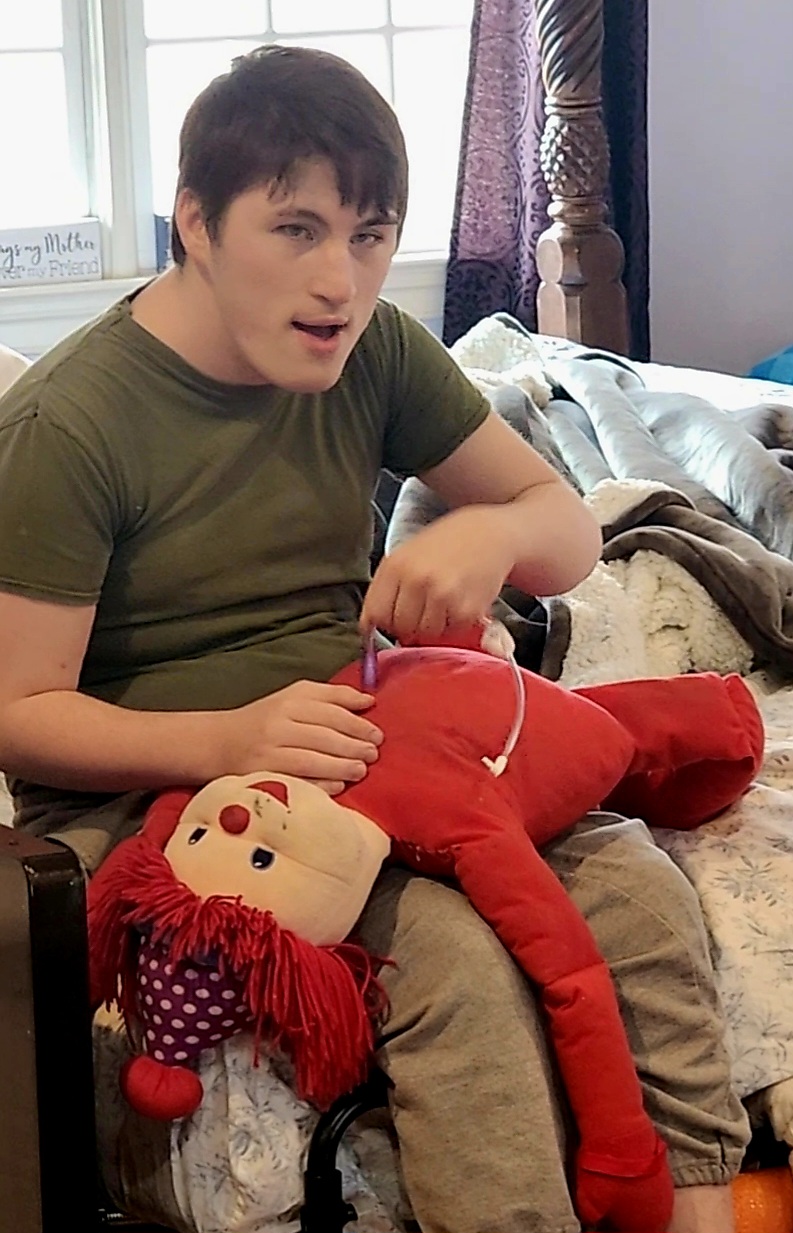
Co-inhabitants
-

Autism
Today is World Autism Day. Every day for us is autism day.
Autism is just one of the many ICD-9s that accompany my son’s medical chart. At last count he had 15.
Wesley was born in October of 2001. Despite multiple ultrasounds by several physicians, I had no idea he would be born any way other than a healthy baby boy until the moment of his birth. How I wish I could say otherwise. Sometimes I wish my story included the part where the amniocentesis came back abnormal but I gave a war cry, pounded my chest and said, “I can do this!”
But God and Wesley held the secret for 37 weeks. Laying on the operating room table I knew something was not quite right. His cry was so quiet. The nurses were somber. No one congratulated me until his dad brought him over.
He said, “Here is our son. He has some anomalies and the geneticist will see him in the morning. Isn’t he beautiful?”
An intense, sudden state of panic overwhelmed me. Joy, excitement, fear, and sadness swirled in my soul and each feeling was indistinguishable in the tornado of such a moment. The human spirit is not meant nor equipped to feel so many emotions at once.
Three weeks later we took Wesley to Omaha, Nebraska to see the geneticist there. As we drove I began bargaining with a God I had barely spoken to over the last ten years. I wasn’t even sure He would remember who I was. I begged Him anyway. Please. It can be anything. Just let me keep my son.
After examining my sweet boy the geneticist sat down with a large text book. He flipped open the page and pointed to a picture.
“We believe your son has Rubinstein-Taybi Syndrome,” he bagan.
The tornado descended once again. I became dizzy. I interrupted.
“Will he be mentally retarded?” I asked.
“I don’t like to label kids,” the geneticist replied. “If you expect him to be a typical child with RTS he will very likely become a typical child with RTS.”
He could see the pleading in my eyes.
“But yes. He will have mental retardation.”
I excused myself to the restroom. Locking the door behind me I collapsed, sobbing on the unforgiving concrete floor.
How I wish I could go back in time and speak with all the knowledge I have accumulated over the last 19 years to that young mom crying. I would say…
Don’t be afraid. You will figure out how to mother this child and he will teach you more than anyone else will without ever saying a word. You will have to fight for him. You will be his voice and he will be your heart. He is going to teach you to love unconditionally with no expectation. He will show you the meaning of perseverance and you’ll learn to take nothing for granted. You will be exhausted right down to your very soul. You will stumble. You will fail. You will get back up and try again because he will need you to. His life is every bit as valuable as everyone else. You will learn to have empathy and compassion for others deemed “less than” in society. Use your voice and use it loudly when need be. You will be a better mother, daughter, and friend because your son was born this way. Life will be amplified from this day on. The highs will be higher but the lows will be lower. This isn’t the day your world ended . This is the day you begin to become who you were meant to be. You will reconnect with your old friend and God will lead, support, and direct you for the rest of your days. Grieve because you have lost a significant dream. But then get up. Dust yourself off. We have work to do.
Autism is not the end of the world but merely a transition into a different one. It is vibrant here. It is silly. It doesn’t make sense to me much of the time but does to my sweet son. This world is challenging. It is rewarding. It is exhausting and so exhilarating. I am a vastly better person for residing here. And after 19 years as a resident, I would have it no other way.
-
The Root
“Expectation is the root of all heartache.”
Have you ever asked a pregnant woman if she was hoping to have a boy or girl? More often than not her response is, “I don’t care as long as it is healthy.” But what happens when your baby is born and it is not healthy? What happens when they hand him to you and say words like “genetics, syndrome, anomalies, life long challenges.” What happens when your reality is the nightmare of others?
You hope but with a hope that is boiled down to its very simplest form. You no longer hope of tossing a football or ballet lessons. You hope that the medicine stops the seizures. You hope you can learn to run a feeding tube pump. You hope the surgery is successful. You hope the doctors are wrong and that your baby will live to see another day. You hope you will somehow survive if they are right.
When I learned to hope for the very basic necessities in order for my son’s life to continue I learned to be thankful for everything else. There have been several times in Wesley’s life when there wasn’t even an expectation he would live. In the absence of expectation hope is still not defeated and the way is paved for something far greater. I have learned to live with no expectations. The fruit that blossomed from that barren tree is excessive gratitude.
Often expectations lead to disappointments and heartache. When we break free from those expectations it is more difficult, though not impossible, to feel disappointed. When you have nothing you are grateful for anything. Sometimes the converse is true. When you have everything you are grateful for nothing.
Anyone with children has likely read, “What to expect when you’re expecting” or “What to expect in the toddler years.” Entire books are dedicated to letting parents know what to expect complete with charts for milestones. I think we often actually find security in living within the lines. Yet some of us are given children for whom none of those rules apply. We do not know what to expect and the experts can’t tell us. It all goes out the window and we live one day at a time, one surgery at a time, one test at a time.
When Wesley was an infant and toddler it was uncertain if he would ever walk, talk, or even eat by mouth. At one year old he weighed only fourteen pounds. His official diagnosis was “failure to thrive.” At the time I felt as if I should receive the diagnosis “failure to mother.” To my heart it was somehow my fault that my baby wasn’t growing appropriately. He wasn’t even on the growth chart, he was well below it.
His first birthday was spent in the hospital after receiving a feeding tube and to this day it remains part of him. For years I had to bolus feed him every four hours and hook him up to a pump at night. It was an intensive, time-consuming process. Not taping the tubing correctly could result in a kink and the alarm would sound. The tubing could and often did become disconnected but continue to pour thirty-two ounces of Pediasure into his crib. He would sleep right through it and I would find him the next morning soaked. When he finally could tolerate food placed in his mouth years later, even pureed, I was not disappointed that it was only stage 1 baby food. On the contrary, I was overjoyed that progress had occurred. I never expected him to eat so when he could I was exceedingly thrilled. At sixteen he still eats baby food but he eats.
He is non verbal other than the two words “Mom” and “Bob”. Those are his priorities – his mother and SpongeBob. He uses simple sign for other needs but decompensates when he cannot express something through sign language. He becomes self-injurious out of sheer frustration.
I used to pray every day that he would speak. I thought if he could he wouldn’t harm himself. I wanted to hear his beautiful voice say “I love you”. I wanted to know how his day was and what happened at school.
But the day never came when Wesley spoke. God answered, “No” and I don’t know why. Something as basic as speech was a milestone he would never hit. I never expected for Wesley to talk so I am not heartbroken that he doesn’t. I hoped, yes, but instead of living in what didn’t happen I move on. I focus on the things he can do and am grateful. I rejoice in the fact that Wesley does say “I love you” even if it is not in the way I hoped and most would expect. I hear it from his soul’s voice and there is no sweeter way to receive it.
Living outside the chart of normalcy can be a scary and wonderful place to exist. We have no guideposts telling us if we are on the right path or how far it is to the next stop. Yet there is incredible freedom. Our definition of excelling is the tiniest amount of progress and no accomplishment is too small for an all out dance party celebration.
When I finally learned to release my expectations I cleared the way for God’s. My disappointments are not His nor are my expectations. What we expect as a culture is not always, perhaps even rarely, the things which God expects. Our society does not value people with chromosomal abnormalities. We expect to have children with the near perfect DNA and above average intelligence. But just what if that wasn’t God’s expectation? What if His expectation is where there is life there is extraordinary value? What if He expects that child with a syndrome would bless every person who came into contact with him like my son does? What if God expects that child to be exalted because he teaches us to give and receive unconditional love? What if God expects us to realize what a privilege it is to have a child with special needs and not the burden as most of society thinks? What if God’s honor roll is not based on the contents of our intellect but the capacity of our hearts? I would declare that the contents of Wesley’s heart are exactly how God intends them to be and he enjoys a place on the highest honor roll.
How much more magnificent and rich yet simple would my life be if I could release all my expectations to allow room for God’s? As with all hopes, dreams, plans, and expectations God’s are always incomparably better.
