Tag: autism

  • Two Crosses

    Two Crosses

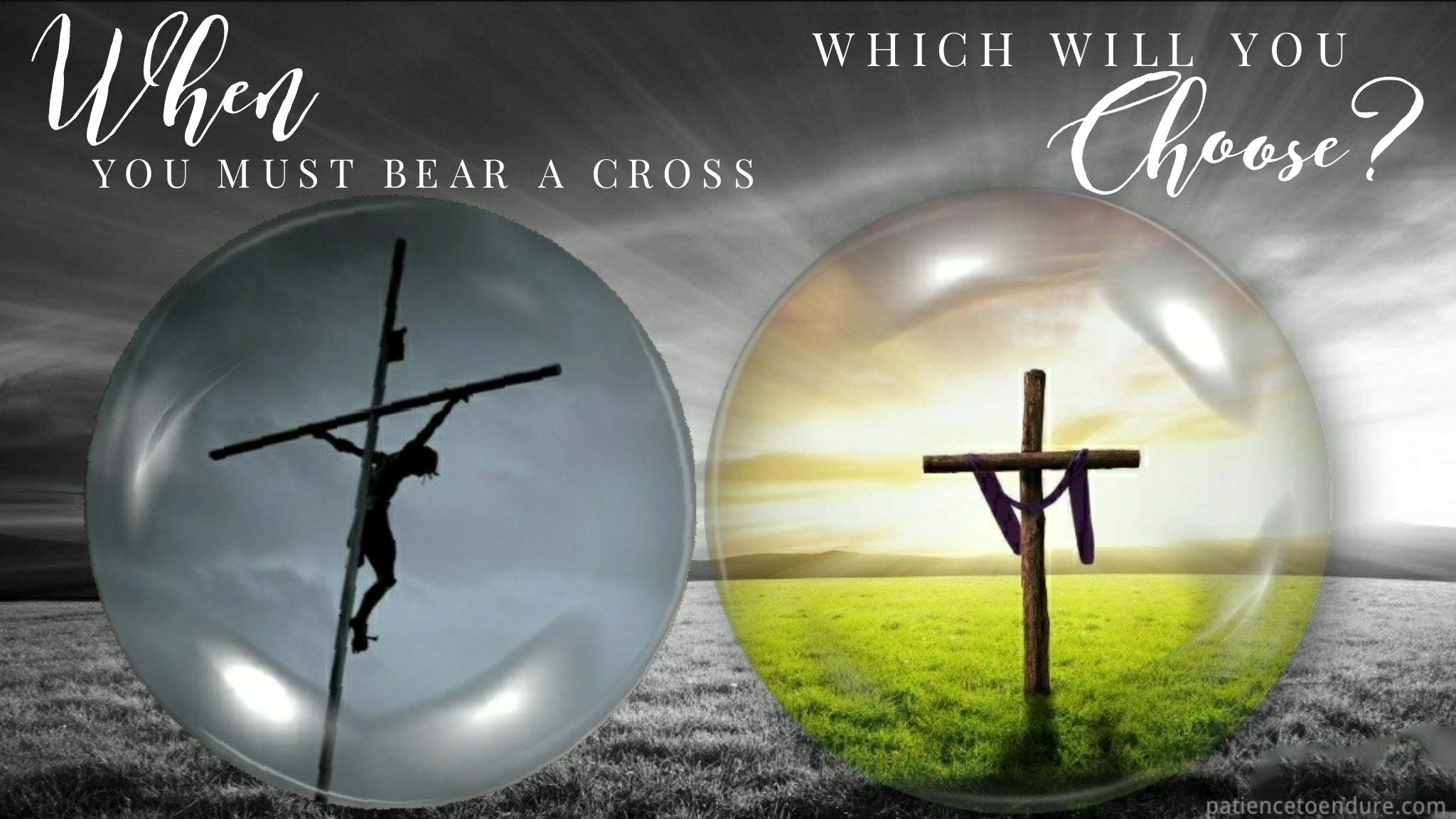
    As Easter approaches I have been thinking about the Cross. To the Romans, at that time, it was a means to inflict the most shame and send a resounding message of defeat. They had several methods of capital punishment but reserved crucifixion to leave a lingering message to their enemies. It was the most painful and disgraceful punishment in an arsenal that included strangulation, stoning, and burning.

    Yet the lingering message the crucifixion of Jesus was not what the Romans intended. As Christians we do not see shame, defeat, or disgrace when we look at a Cross, the symbol of our faith. We see redemption and resurrection. We see victory. We see love so great that even death could not consume it.

    Growing up in the Christian world I have heard, “we all have our cross to bear” countless times. In Luke 9:23 Jesus says “And He said to all, If anyone would come after me, let him deny himself and take up his cross daily and follow me.”

    However, “we all have our cross to bear” was almost always said to me with a negative connotation. We use it when discussing hardship or challenge. The image it would immediately bring to my mind is Jesus carrying His cross up that hill to die.

    But what if that is the wrong image of the cross I bear? Am I thinking of the Roman cross or Jesus’ Cross? Upon the Roman cross is nailed a punishment but upon my Jesus’ cross there is an invitation, the sweetest of proposals. What man meant for torture and shame only by the power of God was transformed to give life and promises both for now and eternity. What was meant to kill a movement changed the entire world and every heart for those who truly believe.

    My thoughts about the cross of Jesus turn to my own personal cross. What is that one thing that was meant to, or could have, destroyed me but by the power and Grace of a loving God became my triumph?

    I live in a complicated, beautiful world of special needs and autism. I can’t recall the specific moment I went from being a timid, frightened mother to a banner waving, “wohoo special needs is awesome” kind of mom. It was a natural progression and at some indescribable moment the cross I carried was transformed from a death sentence to a life promise. I discovered that the cross I bear doesn’t have to be the one society gave me but must be the one God intended for me.

    My mind and my heart made the decision that my cross would represent life and love and power. My faith allowed God the opportunity to give me the ability to accomplish this. Special needs could have destroyed who I was instead of transforming me into who I was meant to be.

    Make no mistake, it is a difficult world in which we who love someone with special needs live. We often feel isolated and different because we are. Other mother’s of teenagers are busy going to basketball games or track meets. I am going to every sensory friendly event offered and doctor appointments with every specialist. I am often exhausted. Everything others take for granted can be and often is an overwhelming challenge to my family.

    It is not easy. It is impossible to not be changed by living in the world of special needs. It is possible to decide what sort of change will take place.

    The world in which we live is colorful. It is filled with hugs and joy. It isn’t about the fact that my son cannot speak, it is about the fact that he speaks with no words. Everything others take for granted can be and often is an overwhelming victory for my family. It is life amplified. The lows are heartbreaking but the highs are found in heights I could only appreciate by having a child like mine.

    I do not choose whether or not I will bear a cross, I choose what my cross looks like and how I carry it. I decide whether or not it will represent shame and disgrace or the glorious promise that God works all things for good. I alone can cast my eyes down in despair or raise my chin and hold my head high.

    What is the cross you must bear? Is it abandonment? Your addiction? The death of a loved one? A medical diagnosis? Mental health struggles? Guilt? Will it be a cross of shame that you hang upon despondent and alone? Or will it be a cross of promise for all to see and perhaps extract hope for themselves?

    The important part to remember is the cross you bear doesn’t have to be a cross of disgrace just because society deems it so. It can become the cross of redemption, resurrection, and victory because God deems it so. He deemed it on Calvery and He deems it in your situation.

    It is entirely up to you to choose which cross you will carry. The rest is up to God and He never fails.

  • Rather A Privilege

    Taking two children to a store doesn’t seem like a big deal. However, Nathan is five ears old and Wesley is sixteen but cognitively closer to a three-year old. He has autism. Genetics are strong, though, and like his mother he loves to go shopping.

    We pulled in to the lot of Target and I turned around to see that Wesley managed to take off both his socks and shoes. I glanced out my window and saw families just jump out of the car and go in. For a moment I envied the simplicity of their lives. I envied the fact that they probably did not even know the ability to go easily into the store was something to be envied.

    I put Wesley’s socks and shoes back on. His feet are deformed and socks do not go on easily so it took a few minutes. I made sure his sippy cup and two extra bottles of Pediasure were in my purse. I grabbed the IPad with the most charge to ensure it wouldn’t die while in the store for that could be catastrophic. I checked that everything had straps and clips to tie to the cart as to not injure anyone from flying objects. Wesley often throws items when he is no longer in need of them. Sometimes he throws them to get your attention because he cannot speak. A simple solution to him can be painful for the one getting hit in the head with a full cup.

    I unstrapped his seat belt which has a special safety device to prevent him from unbuckling himself. Wesley’s brain often takes time to process what is occurring so he rarely gets right out of the car. He has to sit and look around and wait until he understands what we are doing. Life with Wesley requires patience and I don’t mind waiting. Forcing him to move faster only stresses him out in a way I do not understand.

    Finally, we stood outside the car and I looked toward the entrance. It might as well have been a mile away because one million things could happen between where I was and where we needed to be. Wesley might decide he wants to go home. He might want to sit down in the middle of the parking lot and not move until he is ready. He may have a melt down for reasons I will never know. All the while I will have to keep Nathan safe both from cars and Wesley’s “enthusiastic pats”.


    As I began to feel overwhelmed and I had not even reached the store yet I remembered all the times I held him in the Pediatric Intensive Care Unit unsure if he was going to live or die. I thought about the time when he was only one year old and was connected to so many monitors I did not even know what some of them were tracking. He would cry every time I tried to lay him down. I sat in the rocking chair of the hospital most of the night trying with all my strength to stay awake to keep holding him. Eventually I relented and knew sleep would not be defeated. So I placed him in the crib and crawled in next to him. The next morning the nurse came in to find me curled up asleep.  She exclaimed “In all my years here I have never seen this.” I did what I needed to so that he always knew I was near.

    In my heart’s mind I see the faces of dear friends who had to bury their children. I live in a world where children die at a disproportionate rate than most people’s experience. I know those parents would give anything to take 30 minutes to get from the car  in the parking lot to Target. They would give up an appendage to have to put their child’s shoes on for the fourth time before ten o’clock in the morning. I recall standing in a funeral home to offer my sympathy to a mother and father as their child laid in a tiny casket. I remember my heart breaking that they even make caskets that small and that my friends needed to buy one. From their perspective, I am sure, these are not minor inconveniences. Rather, they are privileges.

    Standing in the parking lot I gaze at Wesley and I hear myself whisper, “Thank you Jesus.”

    share_temporary (3)

  • The Root

    “Expectation is the root of all heartache.”

    Have you ever asked a pregnant woman if she was hoping to have a boy or girl? More often than not her response is, “I don’t care as long as it is healthy.” But what happens when your baby is born and it is not healthy? What happens when they hand him to you and say words like “genetics, syndrome, anomalies, life long challenges.” What happens when your reality is the nightmare of others?

    You hope but with a hope that is boiled down to its very simplest form. You no longer hope of tossing a football or ballet lessons. You hope that the medicine stops the seizures. You hope you can learn to run a feeding tube pump. You hope the surgery is successful. You hope the doctors are wrong and that your baby will live to see another day. You hope you will somehow survive if they are right.

    When I learned to hope for the very basic necessities in order for my son’s life to continue I learned to be thankful for everything else. There have been several times in Wesley’s life when there wasn’t even an expectation he would live. In the absence of expectation hope is still not defeated and the way is paved for something far greater. I have learned to live with no expectations. The fruit that blossomed from that barren tree is excessive gratitude.

    Often expectations lead to disappointments and heartache. When we break free from those expectations it is more difficult, though not impossible, to feel disappointed. When you have nothing you are grateful for anything. Sometimes the converse is true. When you have everything you are grateful for nothing.

    Anyone with children has likely read, “What to expect when you’re expecting” or “What to expect in the toddler years.” Entire books are dedicated to letting parents know what to expect complete with charts for milestones. I think we often actually find security in living within the lines. Yet some of us are given children for whom none of those rules apply. We do not know what to expect and the experts can’t tell us. It all goes out the window and we live one day at a time, one surgery at a time, one test at a time.

    When Wesley was an infant and toddler it was uncertain if he would ever walk, talk, or even eat by mouth. At one year old he weighed only fourteen pounds. His official diagnosis was “failure to thrive.” At the time I felt as if I should receive the diagnosis “failure to mother.” To my heart it was somehow my fault that my baby wasn’t growing appropriately. He wasn’t even on the growth chart, he was well below it.

    His first birthday was spent in the hospital after receiving a feeding tube and to this day it remains part of him. For years I had to bolus feed him every four hours and hook him up to a pump at night. It was an intensive, time-consuming process. Not taping the tubing correctly could result in a kink and the alarm would sound. The tubing could and often did become disconnected but continue to pour thirty-two ounces of Pediasure into his crib. He would sleep right through it and I would find him the next morning soaked. When he finally could tolerate food placed in his mouth years later, even pureed, I was not disappointed that it was only stage 1 baby food. On the contrary, I was overjoyed that progress had occurred. I never expected him to eat so when he could I was exceedingly thrilled. At sixteen he still eats baby food but he eats.

    He is non verbal other than the two words “Mom” and “Bob”. Those are his priorities – his mother and SpongeBob. He uses simple sign for other needs but decompensates when he cannot express something through sign language. He becomes self-injurious out of sheer frustration.

    I used to pray every day that he would speak. I thought if he could he wouldn’t harm himself. I wanted to hear his beautiful voice say “I love you”. I wanted to know how his day was and what happened at school.

    But the day never came when Wesley spoke. God answered, “No” and I don’t know why. Something as basic as speech was a milestone he would never hit. I never expected for Wesley to talk so I am not heartbroken that he doesn’t. I hoped, yes, but instead of living in what didn’t happen I move on. I focus on the things he can do and am grateful. I rejoice in the fact that Wesley does say “I love you” even if it is not in the way I hoped and most would expect. I hear it from his soul’s voice and there is no sweeter way to receive it.

    Living outside the chart of normalcy can be a scary and wonderful place to exist. We have no guideposts telling us if we are on the right path or how far it is to the next stop. Yet there is incredible freedom. Our definition of excelling is the tiniest amount of progress and no accomplishment is too small for an all out dance party celebration.

    When I finally learned to release my expectations I cleared the way for God’s. My disappointments are not His nor are my expectations. What we expect as a culture is not always, perhaps even rarely, the things which God expects. Our society does not value people with chromosomal abnormalities. We expect to have children with the near perfect DNA and above average intelligence. But just what if that wasn’t God’s expectation? What if His expectation is where there is life there is extraordinary value? What if He expects that child with a syndrome would bless every person who came into contact with him like my son does? What if God expects that child to be exalted because he teaches us to give and receive unconditional love? What if God expects us to realize what a privilege it is to have a child with special needs and not the burden as most of society thinks? What if God’s honor roll is not based on the contents of our intellect but the capacity of our hearts? I would declare that the contents of Wesley’s heart are exactly how God intends them to be and he enjoys a place on the highest honor roll.

    How much more magnificent and rich yet simple would my life be if I could release all my expectations to allow room for God’s? As with all hopes, dreams, plans, and expectations God’s are always incomparably better.

    share_temporary (1)

  • So What?

    Hope is birthed in and from despair.

    tmp_2018013111302162414

    My middle son, Wesley, has significant special needs. He was born with deletions on his first chromosome and is on the autistic spectrum. Although his chromosome set is incomplete, he is more complete than anyone I know. He loves abundantly and fearlessly. He knows no stranger. I often think and absolutely believe he loves the way God intended us to love – without prejudice, judgment, or reservation.

    During my pregnancy I fully anticipated having a healthy, normal baby boy. Several ultrasounds pointed to this fact and no one saw anything out of the ordinary. The shock that was birthed with him was tremendous but so was the love.

    When he was three weeks old my (now deceased) husband and I along with our two sons traveled to Omaha, Nebraska to see Dr. Bruce Buehler. He was board certified in pediatrics, pediatric genetics and pediatric endocrinology. If anyone could tell us what Wesley’s diagnosis was, we hoped, it was Dr. Buehler.

    The nurse showed us to a very large room with a small table for the children to play, some books, and an exam table. I sat at the little table next to Emerson as he watched his portable DVD player. I wished I could be as he was, oblivious to the seriousness of the situation.

    I could hear his cowboy boots coming from down the hall. The sounds grew louder as he turned the corner, entered the room, and with a smile stuck out his hand to greet us.

    “Dr. Buehler,” Gary said extending his hand.

    “Call me Bruce. No one calls me Dr. Buehler except my wife and that is only when she wants me to take out the trash,” he said with a deep belly laugh.

    He motioned to the table and we sat down as he opened Wesley’s thick chart. By the time we found our way to Omaha the list of abnormalities discovered within Wesley had grown. New doctors had been introduced and before he was even three weeks old Wesley already had a pediatric urologist, neurologist, cardiologist, and gastroenterologist. He had a social worker, a speech therapist, and an occupational therapist. I had to purchase an expandable accordion file to keep track of all his medical needs. The fuller the file became the emptier my heart felt realizing how much my tiny baby had already been through and was yet to face.

    An associate of Dr. Buehler’s joined us and they asked me to place Wesley on the exam table. As a mechanic inspects a car, they examined every inch of his little body.

    “He has a high arch and cleft palate. Did you know that?” his associate asked.

    I shook my head somberly no.

    They excused themselves to confer. We sat in horrible silence waiting.

    After roughly twenty minutes they returned with two textbooks in their hands. Dr. Buehler flipped open the gigantic, blue book. With delicacy he looked at each of us and said,

    “We believe your son has Rubinstein-Taybi Synrome.”

    The room began spinning. Words became incomprehensible. Though part of me knew he had some sort of syndrome when it was confirmed by a physician my entire world collapsed. I could not have known then that the words he spoke would actually be my greatest blessing. It would bring me immense heart ache but also extraordinary joy. It would shape me into a better mother, wife, daughter, friend and human being. Later I would pinpoint that one sentence as the moment in time I began to become who I was meant to be. As it was happening, however, the only thing I could feel was utterly and completely crushed.

    I excused myself to the restroom just across the hall. Closing and locking the door behind me I collapsed to the ground sobbing. How could my life, I wondered, have changed so dramatically and drastically in the amount of time it takes to hear a single sentence? I stayed curled up on the cold, bathroom floor for a while weeping for all I lost. My dreams and my family’s future, I thought, were gone. I could not imagine I would dream new dreams and be given a future far more glorious than one I could have ever created for myself. But hope, you see, had not yet been born.

    How I wish I could speak to myself there on the floor with all the wisdom I have found over the last twenty years. I would say…

    Hope is coming. Hold on. This child will be your greatest teacher without ever speaking a word. In his weakness you will find your strength. You will be his voice and fight for him with all you have. You will reach a new level of exhaustion. You will want to give up. But then you will persevere. You will become a better mother, daughter, and friend because he was born exactly as he is. This isn’t the worst day of your life. This is the day you become who you were meant to be. Grieve because you have lost a significant dream. But then get up. You’ve got work to do.

    After a few minutes I gathered myself, wiped away the mascara that was running down my face, and returned to the exam room.

    “Will he be mentally retarded?” I asked with a whisper. (That was the acceptable term back then).

    “I don’t like to put labels on kids. It can become a self-fulfilling prophecy. But I would say, yes, he will be,” Dr. Buehler said gently.

    “Does he have a normal life expectancy?” I asked. The only thing I could not handle, I knew, was losing him.

    “We are not sure, honestly. The diagnosis was named in the 60’s. Both Dr. Rubinstein and Dr. Taybi are alive and practicing medicine. More than likely, though, he will have a shortened life but there is no reason to believe he won’t live until his 50’s or 60’s,” he replied.

    We returned home to South Dakota and I immediately called my mother who was half way across the country. I could hardly speak as my tears were violently escaping. It would be the first time I spoke the words:

    “My son will be mentally retarded,” I sobbed.

    “So what?” my mother replied calmly.

    There it was. Hope was born in despair.

    “So what?”

    She said it so matter of factly that I might have just as easily told her his eyes were green and I hoped they would be brown. Those two words simultaneously backed me off the ledge and put it all in perspective.

    So what if my child would not learn as quickly as the others? So what if he might hardly learn at all? So what if I might have a perpetual child? So what if he was going to be cognitively impaired. So what?

    My mother’s words handed to me another pearl for my collection. By itself it is still beautiful but not as it was meant to be. I would save this one and add it to the unbreakable string along with my resolve to create a priceless adornment.

    When an irritant enters an oyster or clam, it’s natural defense mechanism secretes a fluid to coat the irritant. Layer upon layer of the coating is deposited until a pearl is formed (pearls.com).

    God can and does instaneously hand me pearls. Other times the jewel must form slowly and methodically as I face adversities as minute as an irritant or as seemingly insurmountable as a formidable foe.

    Wouldn’t it be wonderful if our natural defense mechanism was to create something lustrous and valuable from adversity? That is not my truth. My truth is it takes incredible effort. It takes conscious decisions that are not my natural instinct. I must choose to see the good even when it feels nothing but bad. I must choose to hold on to hope. I must choose my perspective and change it accordingly. I must choose to not allow bitterness and anger come close. I must choose to battle when they do come. And they do. I must choose patience to endure. I must choose to hold to the promises of dreams unrealized. I must choose gratitude. I must choose resilience and perseverance. I must choose to be unconquerable. I must choose faith. I must choose the only way that I, personally, know how to obtain all those things. I must choose God.

    Each and every time.

  • Never lost

    My middle son, Wesley, has deletions on his first chromosome and is on the Autistic Spectrum. Life can be and often is overwhelming for him. His haven, his refuge is the car. He will ask several times a day to go for car rides. It is part of his routine and for twenty minutes several times a day he can “re-set” in the confines of my minivan where the sensory input he is receiving is limited and predictable.

    We have found a few beautiful routes that bring us through Western Albemarle County. The back roads offer horses and cows, mountains and fields. We see gorgeous wineries and tiny cottages.  When we catch the sun at the right moment it takes my breath away. Indeed, I frequently pull the car over to snap a picture of God’s masterpiece.

    Last night I took him on one of the routes I normally take him on during the day. As I was driving I realized how very different it looks under moonlight versus the sunlight. I thought of the irony that the darkness exposed things the light hid. As I continued to drive I could see the silhouette of the mountain in the distance. The majestic site has been a part of my daily living, even subconsciously, and I know the mountain well. I know its shape and size. I recognize the skyline and where it dips and peaks.  I had glanced at it countless times over the last fourteen years. My familiarity with it at some point made the mountain become a point of reference.  It wasn’t as if I had made a concerted effort to study it.  It’s presence in my life was within a close enough proximity that it just became known to me.

    As I continued to drive I realized my GPS was frozen, I had missed a turn, and was on an unfamiliar road. For a moment I felt a tinge of panic trying to figure out where we were. Then I realized if I just kept my eyes on and aimed for the mountain I wasn’t lost. It’s enormous, unmistakable presence even in the dark and in the distance would be my guide. I only needed to know my position relative to it to be safe. The road I was on twisted, turned, and narrowed. At times it even went back on itself. My position was constantly changing but the mountain remained steadfast.

    Even in the dark and foreign terrain I could tell which direction I needed to go because of that resolute and unwavering mountain. Had I been a visitor in an unfamiliar land I would have surely been lost. Had I not paid attention to the intricacy of its shape and size and known it well I might have been confused and followed the wrong mountain.  If I did not appreciate that which surrounds my home and makes it mine I would not have known which way to go.

    We found our way back to the main road. The detour we had taken was not frightening. I was never hopeless or needed to use any other means of finding my way home other than my knowledge of the mountain. I was never lost.  We turned the music up. We danced in our seats. We enjoyed the journey even in the darkness through the unknown. See, it was the certainty that no matter which way the road took us I could maneuver my vehicle ever homeward that gave me peace and kept us safe.

    Life does look different in the dark than in the light. Often we find ourselves in confounding situations. We are thrust suddenly on a path we do not recognize nor did we anticipate. Sometimes it is by our own fault and others it is because of the actions of someone else. But I offer the notion that even in the midst of uncertainty and even darkness there is always music, always laughter, always hope.  You are never lost. You can always find your way if your eyes are fixed on He who does not change and who will guide you safely and triumphantly home.

    road